Looking ahead to 2026, choosing the right Rail Guided Vehicle System supplier is about more than just showcasing a shiny brochure. These days, warehouses want stability in movement, precise routing, safer interactions between humans and machines, and clear, measurable energy efficiency. I mean, even a vehicle stopping just a few centimeters off the mark beside a storage rack can throw off an entire shift, so it’s gotta be reliable.
In this guide, we’ll check out some of the big players—like Daifuku, SSI SCHAEFER, Dematic, KNAPP, Murata Machinery, and Toyota Material Handling. We’ll compare things like how well their systems scale, the design of their rails, how seamlessly their software integrates, how easy it is to do maintenance, the payload capacities, and overall support. Each company tends to shine in different environments—some excel in high-speed distribution centers, while others are better suited for controlled manufacturing setups.
We’re following a practical lesson from quality guru W. Edwards Deming who once said, “A bad system will beat a good person every time.” It’s a good reminder that no matter how fast your vehicle is, it won’t fix bad warehouse data, poor initial setup, or unclear maintenance responsibilities. Nothing replaces real site experience, and of course, solid evidence to back things up.
Now, let’s be real — this isn’t a perfect ranking. Claims from suppliers can sometimes look different when you see how they perform day in and day out. Also, regional service quality can vary, and that can definitely influence your decision. So, we’re mainly focusing on published specs, real-world implementation experiences, integration depth, and long-term dependability. Still, it’s wise to validate things like cycle times, noise levels, spare parts availability, and safety features firsthand during a live demo or visit. While a convincing demo is nice, seeing the equipment in actual operation is the real deal.
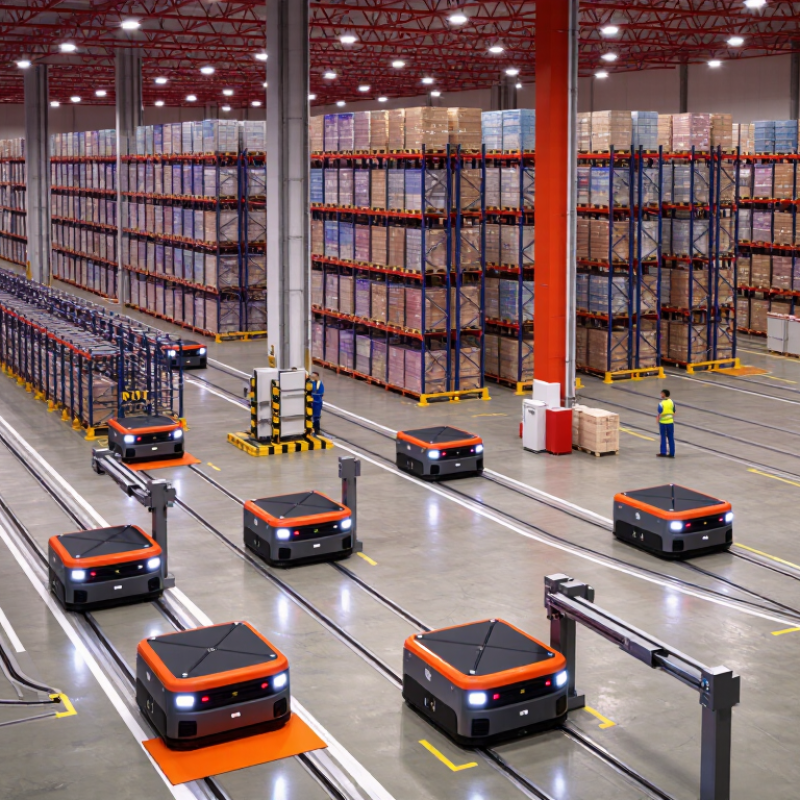
The rails may sit on the floor or inside a production structure. Drive motors, wheels, sensors, controllers, and transfer stations coordinate each movement. In a warehouse, a vehicle can collect a pallet, stop at a scanning point, and deliver it to a storage aisle without a driver.
The system differs from free-roaming Mobile Robots because its route is physically defined. This improves repeatability and simplifies traffic control. However, it can reduce layout flexibility. A misplaced carton or small metal fragment may interrupt movement. That detail is easy to underestimate.
Interact Analysis reported strong expansion in the mobile robot market during 2024, while IFR recorded about 113,000 professional service robots sold for transport and logistics in 2023. These figures include many technologies, not only rail-Guided Vehicles, but they show wider demand for automated material handling.
For a CE Certification Rail Guided Vehicle System, buyers should review risk assessment, emergency stops, guarding, control reliability, and applicable European conformity requirements. “CE certification” is often used commercially, although CE marking is normally based on a documented conformity process. Check the technical file.
Also test stopping distances with real loads, not empty carts. Experienced operators usually inspect rail alignment, wheel wear, switch zones, and software alarms during acceptance trials.
The system may look simple, yet integration with conveyors and warehouse software often creates the hardest problems.
A Rail Guided Vehicle System moves loads along fixed rails, rather than navigating freely across a warehouse. The vehicle receives a dispatch command from warehouse control software. Motors then follow embedded rails, track circuits, or coded guide paths. At each station, sensors confirm position, speed, and load status. A programmable controller manages acceleration, braking, lifting, and transfers.
The system is precise. It can stop beside a pallet rack within millimetres. Photoelectric sensors detect obstacles, while safety scanners create monitored stopping zones. Transfer units can move vehicles between parallel tracks. According to Interact Analysis, warehouse automation investment continues to expand as labour shortages and faster order cycles pressure distribution centres. Its mobile robotics research also identifies coordinated fleet control as a major performance factor. However, rail systems need accurate installation. A small alignment error may create repeated stoppages.
The International Federation of Robotics recorded 541,302 industrial robot installations worldwide in 2023. That figure does not represent rail vehicles directly, but it shows the wider automation environment supporting integrated material handling. When comparing Rail Guided Vehicle System Manufacturers, buyers should examine throughput, rail expansion, maintenance access, and software compatibility. The MHI Annual Industry Report also highlights ongoing investment in automation and digital supply-chain tools. Yet specifications can look better than daily performance. I would test recovery after a blocked station, not only the advertised cycle time. A practical trial reveals more.
Core Components of a High-Quality Rail Guided Vehicle System
A High-Quality Rail Guided Vehicle System begins with a rigid guide rail and accurately aligned tracks. Small installation errors can create vibration, wheel wear, and positioning drift. The vehicle chassis needs a reliable drive motor, load platform, brakes, and sensors. These parts must work together under changing pallet weights and repeated stop-and-go cycles.
The control layer is equally important. A programmable controller manages routing, speed, docking, and communication with warehouse software. Laser, magnetic, or optical sensors help detect position and obstacles. Safety circuits should support emergency stops, guarded zones, and controlled acceleration. The International Federation of Robotics reported 541,302 industrial robots were installed worldwide in 2023. This figure shows the wider demand for automated movement, but RGV performance still depends on the track, not only the controller.
Power rails, batteries, charging units, and data networks complete the system. Poor contact can stop a vehicle beside a loaded rack. MHI’s 2024 Annual Industry Report found that 55% of supply-chain leaders planned to adopt robotics and automation within one to two years. That pressure may encourage rushed designs. I would not specify capacity from catalog figures alone. Real testing should measure cycle time, noise, braking distance, and maintenance access with actual loads. Perfect assumptions rarely survive a busy shift.
In 2026, leading rail guided vehicle suppliers will be judged by application results, not impressive rankings. Their systems support precise movement in automotive plants, distribution centers, hospitals, airports, and clean manufacturing rooms. A rail guided vehicle can carry parts between assembly stations, move pallets through narrow aisles, or deliver sterile materials with fewer manual transfers. That matters when floor space is limited and timing errors are costly.
Practical supplier evaluation should include load testing, route simulation, control-system integration, and documented commissioning procedures. Automotive users may need high-frequency shuttle movement. Hospitals often require quiet operation and reliable tracking. Food facilities may prioritize washable surfaces and controlled access. A fast cycle time looks attractive, but it can hide difficult maintenance. No design is perfect. Real performance also depends on floor accuracy, operator training, battery planning, and emergency access.
Tips: Ask suppliers for application-specific references, service response times, spare-parts policies, and safety test records. Request a realistic demonstration using your heaviest load and longest route. Check how the system behaves during sensor faults or temporary network loss. Small details matter. A supplier that explains limitations clearly may be more dependable than one promising effortless automation.
Choosing among 2026 RGV system suppliers requires more than comparing equipment prices. Evaluate their experience with loads, travel distances, production rhythms, and warehouse conditions similar to yours. Ask for documented projects, measured availability, and clear explanations of past failures. A supplier who discusses problems openly may be more reliable than one promising perfect performance.
Examine the proposed system in detail. Check payload capacity, positioning accuracy, transfer speed, rail alignment, and emergency stopping behavior. Request layout drawings with maintenance access included. Confirm how the control software communicates with warehouse or production systems. During factory acceptance testing, use your actual pallets, load weights, and operating cycles. Small differences matter.
Service quality often decides long-term value. Review spare-parts availability, remote support, technician response times, training, and software update policies. Ask who owns the source data and how faults are recorded. Calculate energy use, maintenance labor, downtime risk, and expansion costs, not only the purchase price. Floor flatness and temperature changes may affect performance, yet these details are sometimes underestimated. I would also challenge unusually high capacity claims. A faster vehicle can create congestion at transfers. The lowest quote may be reasonable, but only after its exclusions are visible.
| Evaluation Dimension | What to Compare | Typical RGV Benchmark or Target | Evidence to Request from the Supplier | Suggested Weight |
|---|---|---|---|---|
| Load Capacity | Rated payload, load distribution, pallet or carrier dimensions, and allowance for tooling or fixtures. | Common systems cover approximately 50–2,000 kg per vehicle; the selected rating should exceed the maximum operating load with a documented safety margin. | Technical datasheet, load test report, carrier drawing, and calculations for the heaviest and most off-centre load. | 12% |
| Positioning Accuracy | Repeatability at workstations, transfer points, lifts, buffers, and storage locations. | Typical repeatability is approximately ±1–5 mm, depending on rail condition, vehicle design, speed, and interface requirements. | Factory acceptance test results, measurement method, tolerance definition, and sample positioning records. | 12% |
| Travel Speed and Throughput | Maximum speed, acceleration, deceleration, spacing, transfer time, and achievable moves per hour. | Many industrial RGV applications operate around 0.5–2.0 m/s; throughput must be calculated from the complete route cycle rather than travel speed alone. | Cycle-time simulation, route layout, acceleration profile, traffic assumptions, and guaranteed throughput calculation. | 12% |
| System Availability | Expected uptime, mean time between failures, recovery procedures, and the effect of a vehicle or control fault. | A mature design should provide a documented availability target, fault recovery strategy, and operating data from comparable installations. | Availability definition, service-level agreement, failure-history summary, preventive-maintenance plan, and recovery-time commitment. | 12% |
| Control-System Integration | Communication with warehouse control systems, manufacturing execution systems, warehouse management systems, PLCs, lifts, conveyors, and safety devices. | Look for documented industrial communication interfaces, clear command and status structures, alarm handling, and traceable transaction records. | Interface specification, network architecture, API or protocol documentation, sample data mapping, and integration responsibility matrix. | 12% |
| Safety and Compliance | Machine guarding, emergency stops, access control, collision prevention, safe speed functions, and risk assessment. | The system should be designed against applicable local machinery, electrical, electromagnetic compatibility, and workplace-safety requirements. | Risk assessment, safety circuit drawings, conformity documentation, safety-component list, validation report, and user manual. | 12% |
| Rail and Installation Requirements | Rail tolerance, floor loading, installation accuracy, alignment method, expansion joints, switches, crossings, and cleanroom requirements where applicable. | Rail geometry and floor conditions can directly affect accuracy, noise, wheel wear, and availability; installation tolerances must be specified before quotation. | Rail layout, civil-work requirements, tolerance table, installation procedure, alignment records, and site acceptance criteria. | 8% |
| Scalability and Flexibility | Ability to add vehicles, stations, branches, buffers, lifts, carriers, and new production routes without replacing the main control platform. | A scalable architecture should support modular expansion, route reconfiguration, and capacity increases with defined software and hardware limits. | Expansion design example, maximum vehicle count, controller capacity, software licensing model, and change-management procedure. | 8% |
| Energy and Operating Cost | Vehicle power consumption, charging or power-transfer method, standby consumption, consumables, and maintenance cost. | Compare total energy and maintenance cost per operating hour or per move; regenerative braking and efficient standby control may reduce consumption. | Energy measurement method, duty-cycle assumptions, spare-parts price list, maintenance hours, and five-year total-cost model. | 6% |
| Maintenance and Spare Parts | Access to motors, wheels, sensors, drives, communication modules, batteries or power collectors, and diagnostic tools. | Prefer designs with condition monitoring, standard replaceable modules, documented maintenance intervals, and locally available critical spares. | Maintenance manual, spare-parts list, recommended stock level, diagnostic workflow, technician training plan, and response-time commitment. | 6% |
| Project Delivery Capability | Engineering resources, simulation capability, project governance, installation experience, commissioning method, and change control. | Evaluate the supplier using references for systems with similar load, route length, throughput, interfaces, and operating environment. | Project schedule, responsibility matrix, commissioning plan, risk register, reference-site details, and acceptance-test procedure. | 5% |
| Commercial and Lifecycle Value | Purchase price, installation, software, training, warranty, upgrades, service contracts, spare parts, and decommissioning costs. | Select on total cost of ownership rather than equipment price alone; compare at least a five-year cost period using the same operating assumptions. | Itemized quotation, warranty terms, license conditions, escalation clauses, service rates, upgrade policy, and five-year lifecycle-cost worksheet. | 5% |
The 2026 rail guided vehicle market is becoming more specialized. Suppliers now serve warehouses, factories, cold storage sites, and high-throughput distribution centers. Their systems commonly include rail vehicles, transfer stations, charging units, control software, and safety sensors. Regional suppliers often understand local building codes and maintenance conditions better. International suppliers may offer broader integration experience. Neither advantage guarantees a better project result.
Field evaluations show that route accuracy is only one purchasing factor. Buyers should examine payload stability, cycle time, noise levels, emergency recovery, and spare-part access. A vehicle moving smoothly at 2 a.m. matters more than a polished demonstration. Interfaces should connect with warehouse control systems and production software. Cybersecurity also deserves careful review. Some suppliers still provide impressive hardware but limited diagnostic support. That gap can become expensive after installation.
In 2026, rail guided vehicle systems are becoming more intelligent, connected, and service-oriented. A capable Rail Guided Vehicle System Manufacturer now designs beyond transport hardware. Systems increasingly combine digital twins, real-time fleet monitoring, machine vision, and predictive maintenance. The International Federation of Robotics reported 541,302 industrial robots installed worldwide in 2023. This wider automation environment is accelerating demand for reliable material movement.
RGV technology is also shifting toward modular control architecture. Operators can adjust routes, storage positions, and loading priorities without rebuilding the entire line. Cloud dashboards can display motor temperature, cycle counts, stoppages, and maintenance alerts. Small details matter. A delayed pallet can disturb an entire production schedule. MHI’s 2024 Annual Industry Report found that 55% of surveyed supply-chain professionals were already using robotics and automation. That figure suggests adoption is practical, not experimental.
Service quality may become the stronger differentiator. Remote diagnostics, spare-parts planning, operator training, and response-time agreements reduce hidden downtime. Energy-efficient drives and regenerative braking are gaining attention as electricity costs remain difficult to predict. Cybersecurity also deserves more attention, especially when vehicles connect with warehouse software. The technology is not frictionless. Integration with older conveyors can still create awkward delays. A misplaced sensor may stop a precise system. Reality is messier. Buyers should examine maintenance records, interface standards, safety validation, and local technical support before selecting a supplier.
Representative payload classes used in rail guided vehicle applications, showing the shift from unit-load automation toward pallet, dual-load, and heavy-duty material transfer.
The values represent common industrial design classes rather than market share or supplier-specific specifications. Actual payload capacity depends on vehicle configuration, rail design, acceleration limits, load dimensions, and required safety margins.
China’s dual-vehicle linkage AGVs are attracting attention as manufacturers seek more flexible and efficient solutions for modern logistics. Insights associated with IFR and Interact Analysis reports highlight the growing importance of intelligent material handling, autonomous navigation, and scalable automation. A linked two-vehicle configuration can support the movement of longer or heavier loads while maintaining coordinated operation, helping factories improve workflow efficiency in warehouses, production lines, and distribution areas.
This AGV solution uses advanced differential drive technology, allowing precise turning, smooth maneuverability, and reliable movement in confined spaces. Its wireless power supply system reduces dependence on traditional charging connections and supports continuous operation with fewer interruptions. The design also offers high compatibility with various equipment and production environments, making it suitable for integration with conveyors, storage systems, lifting platforms, and other automated devices.
Manufactured in China, these AGVs are developed with reliability, operational stability, and practical deployment in mind. Their modular structure enables manufacturers to adapt vehicle capacity, control functions, and navigation requirements according to specific logistics tasks. For factories seeking to modernize internal transportation, reduce manual handling, and build a more responsive automation system, dual-vehicle linkage AGVs provide a dependable option for improving material flow and supporting long-term operational efficiency.
It is an automated transport system that moves carts along fixed floor or elevated rails. Motors, wheels, sensors, and controllers coordinate each movement. A cart may collect a pallet, pause for scanning, then enter a storage aisle.
Its route is physically defined by rails. This usually improves repeatability and traffic control. However, fixed rails reduce layout flexibility. A misplaced carton or metal fragment can stop the route.
They move parts in factories, pallets in warehouses, and supplies in hospitals. They can also serve airports, cold storage areas, and clean production rooms. Narrow aisles are a practical advantage.
Test the heaviest load on the longest route. Measure stopping distances with real payloads, not empty carts. Simulate sensor faults, network loss, and power interruptions. A polished demonstration is not enough.
Review risk assessments, emergency stops, guarding, and control reliability. Check rail crossings, transfer stations, and emergency access. For European use, verify the documented conformity process and technical file. Terminology can be confusing.
Request similar project references, measured uptime, and service response times. Review spare-parts policies, maintenance records, and operator training plans. Ask about limitations directly. Honest answers may matter more than impressive promises.
Inspect rail alignment, wheel wear, switch areas, sensors, and software alarms. Battery planning also affects availability. Dust, small debris, and worn wheels can create delays. The system is not maintenance-free.
Integration with conveyors, warehouse controls, and production software can be difficult. Confirm data interfaces, alarms, permissions, and recovery procedures. Cybersecurity also deserves review. Hardware alone cannot complete the project.
Not necessarily. Compare installation, software updates, warranty coverage, spare parts, and technician response. A cheaper quote may create higher operating costs later. That possibility should be tested, not assumed.
A Rail Guided Vehicle System is an automated material-handling solution that moves loads along fixed rails with accuracy, stability, and reliable scheduling. This article explains how vehicles receive commands, navigate defined routes, load and unload materials, and communicate with control software. It also reviews core components, including guided vehicles, rails, drive units, sensors, transfer mechanisms, safety devices, and supervisory control systems. These systems support modern warehouses, manufacturing plants, distribution centers, clean production areas, and other environments where efficient and repeatable transportation is essential.
The article also presents practical criteria for evaluating suppliers, such as system capacity, route flexibility, integration capability, safety performance, maintenance support, customization, energy efficiency, and long-term service quality. It outlines the 2026 global supplier landscape from a technology-focused perspective without emphasizing individual companies, while highlighting emerging trends such as smarter fleet coordination, predictive maintenance, modular designs, digital monitoring, improved battery systems, and stronger integration with warehouse and production software.