You know, with how much technology is sneaking into business operations these days, it’s not surprising to see more and more companies turning to Mobile Robots. I read somewhere that, according to the International Federation of Robotics, the global market for these robots is expected to hit over $20 billion by 2025 — that's a pretty hefty jump, with growth rates climbing past 25% yearly. It really shows how these robots could be a game-changer, helping boost productivity, cut down costs, and make workflows smoother across industries like manufacturing, logistics, and even healthcare.
But here’s the thing — when a business starts looking into automation, picking the right Mobile Robot isn’t exactly a walk in the park. You need to think about things like the environment it’ll be working in, what kind of tasks it needs to handle, and whether it’s scalable for future needs. The market's pretty crowded, too — there are tons of options, each suited to different jobs, which can make decision-making a bit overwhelming. So, it’s really important for companies to understand what each robot can do — the key features, how they operate — so they can pick something that not only works now but can grow with them down the road. Basically, a smart choice today can lead to more innovation and growth tomorrow.
Understanding Your Business Requirements for Mobile Robots
When considering the implementation of mobile robots in your business, the first step is to thoroughly understand your specific requirements. Each business operates in varied environments and has unique operational tasks, which means identifying key areas where mobile robots can provide value is essential. For instance, think about whether you need a robot to handle repetitive tasks, improve inventory management, or enhance customer service. By mapping out these needs, you can align the capabilities of potential mobile robots with your operational goals.
In addition to task requirements, analyzing the layout and infrastructure of your workspace is crucial. The robot must be compatible with your existing systems and workflows. Consider factors such as the size of your facility, the complexity of your operational processes, and any obstacles that might hinder robot navigation. Understanding these physical limitations allows you to select a robot that can seamlessly integrate into your environment, ensuring efficiency and maximizing productivity. The better you assess your needs and constraints, the more effectively you can choose a mobile robot that enhances your business operations.
Evaluating Different Types of Mobile Robots Available
When evaluating different types of mobile robots available for business needs, it is essential to start by identifying the specific tasks they will perform. Various types of mobile robots are designed for specific functions, such as material handling, delivery services, or inspection tasks. For instance, autonomous mobile robots (AMRs) are ideal for navigating complex environments and can transport goods within warehouses. In contrast, Guided Vehicles often require predefined paths but excel in repetitive tasks. Understanding the primary function of each type is crucial for making an informed decision.
Additionally, considering the operational environment is vital in selecting a suitable mobile robot. Factors such as space constraints, floor types, and the presence of obstacles play significant roles in determining the robot's efficiency. Some robots are equipped with advanced sensors and mapping technologies that allow them to adapt to dynamic environments, while others may need more structured settings. Evaluating the robot's ability to integrate with existing systems and its scalability for future needs also matters. Careful consideration of these factors will help businesses choose the right mobile robot that aligns with their operational requirements and goals.
How to Choose the Best Mobile Robot for Your Business Needs
| Robot Type | Payload Capacity | Operating Environment | Navigation Technology | Battery Life | Cost Estimate |
| Autonomous Mobile Robot (AMR) | Up to 200 kg | Indoor/Outdoor | LiDAR, Camera-Based | 8-12 hours | $20,000 - $100,000 |
| Delivery Robot | 10-30 kg | Indoor | GPS, Ultrasonic | 6-8 hours | $5,000 - $30,000 |
| Cleaning Robot | Up to 50 kg | Indoor | Mapping, Sensor-Based | 4-10 hours | $3,000 - $15,000 |
| Forklift Robot | Up to 1500 kg | Indoor | Infrared, Laser | 6-12 hours | $30,000 - $120,000 |
| Agricultural Robot | Up to 300 kg | Outdoor | Differential GPS, Vision | 10-15 hours | $25,000 - $150,000 |
Key Features to Look for in a Mobile Robot
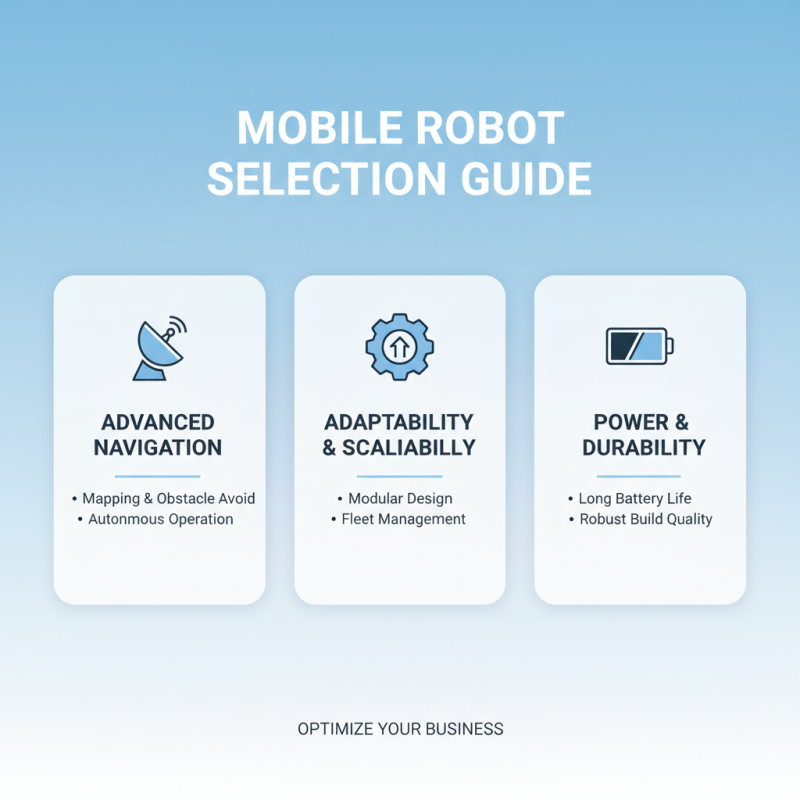
When selecting a mobile robot for your business, certain key features should be prioritized to ensure optimal performance and fit for your specific needs. First and foremost, consider the robot's navigation capabilities. Advanced mapping and obstacle avoidance technology are crucial for efficient operation in dynamic environments. Look for robots equipped with sensors that allow them to navigate complex spaces autonomously, minimizing the risk of collisions and enhancing overall safety.
Another critical feature to evaluate is the load capacity of the robot. Depending on your operational requirements, it is essential to choose a robot that can handle the weight and size of the materials or products you need to transport. Additionally, assess the battery life and charging options available. A mobile robot with a longer battery life and efficient charging system will minimize downtime and maintain productivity. Finally, ensure the robot can integrate seamlessly with your existing software and systems, providing ease of use and enhancing overall workflow efficiency.
Assessing Integration with Existing Systems and Workflows
When selecting a mobile robot for your business, a critical factor to consider is how well it integrates with your existing systems and workflows. This integration can significantly affect the efficiency and productivity of your operations.
Start by assessing your current processes: identify areas where the robot can complement or enhance your workflows. For instance, look into your inventory management systems, production lines, or data processing tasks to pinpoint how a mobile robot can streamline these activities.
Furthermore, it is essential to evaluate the compatibility of the mobile robot with your current technology stack. This includes understanding whether the robot can interface with your software, hardware, and communication systems. A well-integrated mobile robot should not require significant changes to your existing infrastructure but rather seamlessly fit into it, reducing disruption and promoting ease of use.
Prioritize robots that support standardized communication protocols and offer user-friendly interfaces, ensuring that your team can adapt quickly and effectively. By focusing on integration, businesses can maximize the return on their robotic investments and enhance overall operational efficiency.
Budget Considerations for Mobile Robot Acquisition
When considering the acquisition of mobile robots for your business, budget is a critical factor that should not be overlooked. The initial investment often extends beyond just the purchase price of the robot; it encompasses a variety of additional costs that can impact your overall financial planning. Businesses should account for expenses related to installation, maintenance, software licensing, and potential training for staff who will operate these advanced systems. Therefore, developing a comprehensive budget plan is essential to ensure that the total cost of ownership is manageable and aligns with the long-term financial goals of your organization.
Another important aspect to consider is the return on investment (ROI) that mobile robots can deliver over time. While the upfront costs may seem daunting, the efficiencies gained through automation in logistics, manufacturing, or service sectors can lead to significant cost savings in labor and operational processes. Businesses should carefully evaluate the potential productivity gains and how quickly these can offset the initial expenditure. By conducting a thorough cost-benefit analysis and assessing how these robots will integrate into existing workflows, organizations can make informed financial decisions that ultimately enhance their competitiveness in the market.
Vendor Support and Maintenance Options
When selecting a mobile robot for your business, one critical factor to consider is the vendor support and maintenance options offered. According to a report by the International Federation of Robotics, over 30% of operational downtime in automated systems is attributed to inadequate support and maintenance. A reliable vendor should provide comprehensive support that includes timely troubleshooting, software updates, and part replacements. This not only mitigates potential disruptions but ensures that your robotic systems operate at peak efficiency.
Furthermore, research from the Robotics Industry Association indicates that businesses that engage with vendors offering robust maintenance plans see a significant increase in their robots' longevity and performance, with up to 20% reductions in operational costs. An optimal support agreement should encompass proactive monitoring, regular maintenance schedules, and easy access to technical assistance. By choosing a vendor that prioritizes these aspects, businesses can achieve greater return on investment and maximize productivity through minimal downtime.
Long-term Scalability and Future-Proofing Your Investment
When choosing the best mobile robot for your business needs, long-term scalability and future-proofing should be at the forefront of your decision-making process. Investing in a mobile robot that can adapt to evolving technology and operational demands is crucial. This ensures that your investment remains viable as market conditions shift, technological advancements occur, and your business grows. Selecting a robot that supports easy upgrades and modular components can significantly enhance its longevity and performance.
Tips: Consider assessing the compatibility of the robot with existing systems and how it can integrate into your current workflow. Additionally, prioritize robots designed for easy software updates, enabling you to leverage the latest advancements in automation without needing a complete replacement.
Another vital aspect is to examine the support and resources available from the manufacturer. A company with a strong commitment to innovation and customer service can provide updates and enhancements that keep your mobile robot aligned with industry standards. This foresight not only safeguards your initial investment but also maximizes the robot's efficiency over time, ultimately supporting your business's long-term success.
Tips: Engage with user reviews and community feedback regarding the manufacturer’s responsiveness to technological changes and support services. A thriving user community can also provide valuable insights into future capabilities and applications of the robot, enhancing your decision-making process.
FAQS
: Businesses should start by identifying the specific tasks the robots will perform, as different types are designed for functions such as material handling, delivery, or inspection.
The operational environment affects a robot's efficiency, with factors like space constraints, floor types, and obstacles playing significant roles. Some robots are better suited to dynamic environments, while others require structured settings.
Key features to consider include navigation capabilities, load capacity, battery life, and the ability to integrate with existing systems to ensure optimal performance and workflow efficiency.
Advanced navigation capabilities, such as mapping and obstacle avoidance technology, are crucial for enabling robots to operate efficiently in dynamic environments, helping them avoid collisions and enhancing safety.
Load capacity is essential to ensure that the robot can handle the weight and size of the materials or products that need to be transported without risking damage or inefficiency.
Businesses should evaluate their current processes to identify areas where a robot can enhance workflows and check the robot's compatibility with existing software, hardware, and communication systems.
A well-integrated mobile robot reduces disruption during implementation, enhances user friendliness, and maximizes the return on investment by streamlining processes and improving operational efficiency.
Robots with longer battery life and efficient charging minimize downtime, which is crucial for maintaining productivity in operations.
Businesses should seek robots equipped with advanced sensors that enable them to navigate complex spaces autonomously, improving safety and operational efficiency.
When choosing a mobile robot, businesses should assess its scalability, ensuring that it can grow and adapt alongside their operational requirements over time.
Conclusion
When choosing the best mobile robot for your business, it’s crucial to first understand your specific operational needs. You should evaluate the various types of mobile robots available, considering their key features such as navigation capabilities, payload capacity, and battery life. Additionally, assess how well the mobile robot can integrate with your existing systems and workflows to maximize efficiency.
Budget considerations play a significant role in the decision-making process, as well as the support and maintenance options offered by vendors. It's also important to think about the long-term scalability of the mobile robot to ensure your investment remains viable as your business evolves. By carefully analyzing these factors, you can select a mobile robot that not only meets your current demands but also adapts to future challenges.