

Mobile Robotics for Smart Manufacturing in Heavy Mining Equipment
From Discrete Production to an Integrated Smart Manufacturing System
Sept. 27. 2026
As smart manufacturing moves from concept to the shop floor, the real challenge is not simply deploying more robots. It is creating a production environment in which automated systems can work reliably together and deliver measurable value.
This challenge is particularly relevant to discrete manufacturing industries such as heavy equipment and automotive production, where long process chains, diverse materials and complex production flows can make coordination increasingly difficult as factories expand.
LGIM addresses this challenge through integrated Mobile Robotics, intelligent logistics and digital production systems—connecting equipment, material flow and production processes to enable a more coordinated and flexible manufacturing environment.
01 | Heavy Mining Equipment Manufacturing
From Discrete Operations to an Integrated Smart Factory
In conventional heavy mining equipment manufacturing, production activities are often highly distributed. Final assembly, sub-assembly and warehousing operate as separate functions, while material movement relies heavily on manual handling and forklift operations.
This can result in significant waiting time, repeated material handling and inefficient coordination between processes.
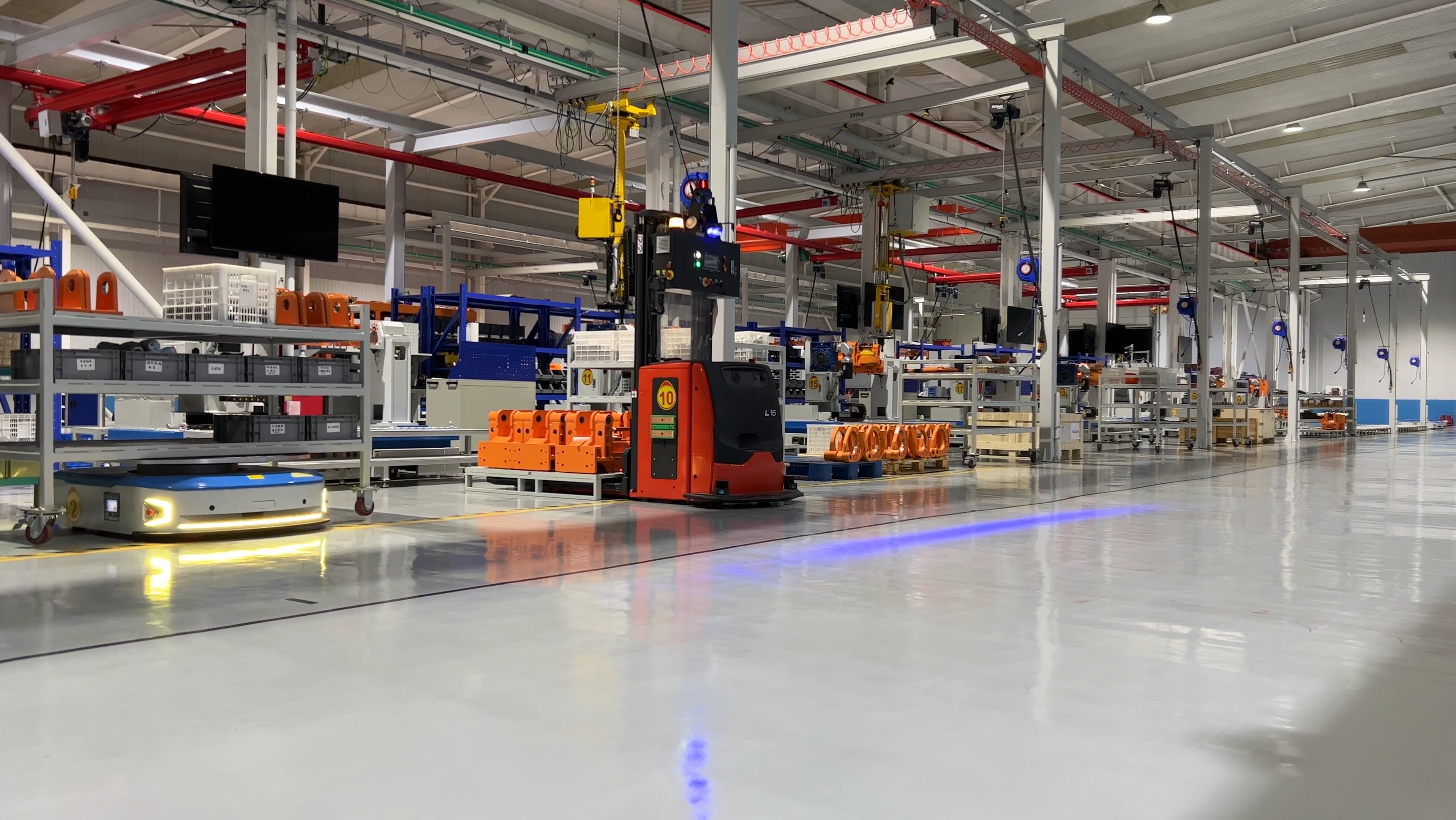
For a leading mining equipment manufacturer in China, LGIM developed a customised digital smart workshop that integrates production, warehousing and intralogistics into a unified manufacturing system.
Following implementation, production efficiency increased by nearly three times. The key was not the introduction of a single advanced machine, but the systematic redesign of the workshop as an integrated production environment.
One Workshop. Three Integrated Systems.
The redesigned workshop consists of three major functional areas:
- Centralised Final Assembly Line
The core assembly area for the final assembly of the main products.
- Multiple Specialised Sub-Assembly Lines
Dedicated lines for pre-assembling components and feeding completed sub-assemblies into the final assembly process at the required pace.
- Multi-Functional Storage Area
An integrated storage system combining Automated Storage, small-parts storage and floor-level storage to accommodate different material types and storage requirements.
Across the workshop, AGVs, laser-guided forklifts, stacker cranes and customised automation equipment work together to create an integrated production flow covering the entire process—from inbound material storage and sub-assembly through to final assembly and product output.
What Drives the Nearly 3× Efficiency Improvement?
The improvement does not come from any single piece of equipment. It results from the coordinated operation of production, warehousing and intralogistics as one system.
- Production-driven material preparation
The storage system automatically prepares materials according to the production plan, while AGVs deliver them to workstations in line with the required production takt.
- Connected sub-assembly and final assembly
Digital systems connect the sub-assembly and final assembly processes, helping reduce work-in-process accumulation and improve production continuity.
- Automated high-level handling
Laser-guided forklifts and stacker cranes replace manual high-level handling operations, improving operational efficiency while reducing associated safety risks.
The result is a workshop in which material flow is no longer managed as a series of isolated handling tasks, but as an integral part of the production process.
02 | Automotive Assembly
Reconfiguring High-Automation Manufacturing with Mobile Robots
The project deploys more than 90 heavy-duty assembly AGVs, coordinated through a centralised intelligent fleet management system.
Equipped with contactless charging technology, the AGVs can support continuous 24-hour operation, enabling a highly automated and flexible assembly environment.
Three Key Capabilities
- Flexible Material and Product Flow
AGVs replace conventional fixed conveyor systems, allowing the production layout to be reconfigured according to manufacturing requirements without being constrained by fixed physical tracks.
- Automated Multi-Model Production and Rotation
Different vehicle models, including light-duty trucks and pickup trucks, can be produced on the same line. Based on production scheduling commands, AGVs automatically adapt to the required process route and vehicle model. Selected stations also support automatic workpiece rotation to accommodate different assembly orientations.
- Digitally Connected Assembly Operations
The position, operating status and carried materials of each AGV are connected in real time with the MES system. Production takt, material delivery and quality traceability are therefore integrated into a digital production workflow.
This creates a production line where material movement, production scheduling and process information are coordinated through a unified digital system.
03 | From Manufacturing to Smart Manufacturing
A Scalable Model for Intelligent Factory Transformation
Following implementation, the workshop achieved comprehensive improvements across quality, productivity and cost efficiency, supported by the integration of digital and intelligent hardware and software systems.
The transformation extends beyond individual pieces of equipment. By connecting production processes, material storage, mobile robotics and digital management, the project demonstrates how a conventional manufacturing workshop can evolve into a more integrated and responsive production system.
For heavy mining equipment manufacturers, this provides a scalable and replicable approach to smart manufacturing transformation.
Building the Next Generation of Intelligent Manufacturing
At LGIM, we believe that intelligent manufacturing is not simply about deploying more automation. It is about creating systems in which people, equipment, materials and information work together more efficiently.
With a continued focus on mobile robotics and intelligent intralogistics, LGIM works alongside manufacturers to build more flexible, connected and efficient production environments—from individual processes to complete smart workshops.